Black and White Film Types for Film Photography
There are a number of black and white (b&w) films available for 35mm film cameras and medium format film cameras that can still be found in stores. While there are also a number of special films that require unique processing, it would be best to work with the basic black and white film types and learn how the film works before using these special films. The three major brands of black and white films are Kodak, lford, and Fuji. Unfortunately, the best advice for any beginner in black and white film photography, like color film or slide film photography, would be to try a variety of brands and subtypes within those brands to find the right film for you.
How Black and White Film Works for Film Photography
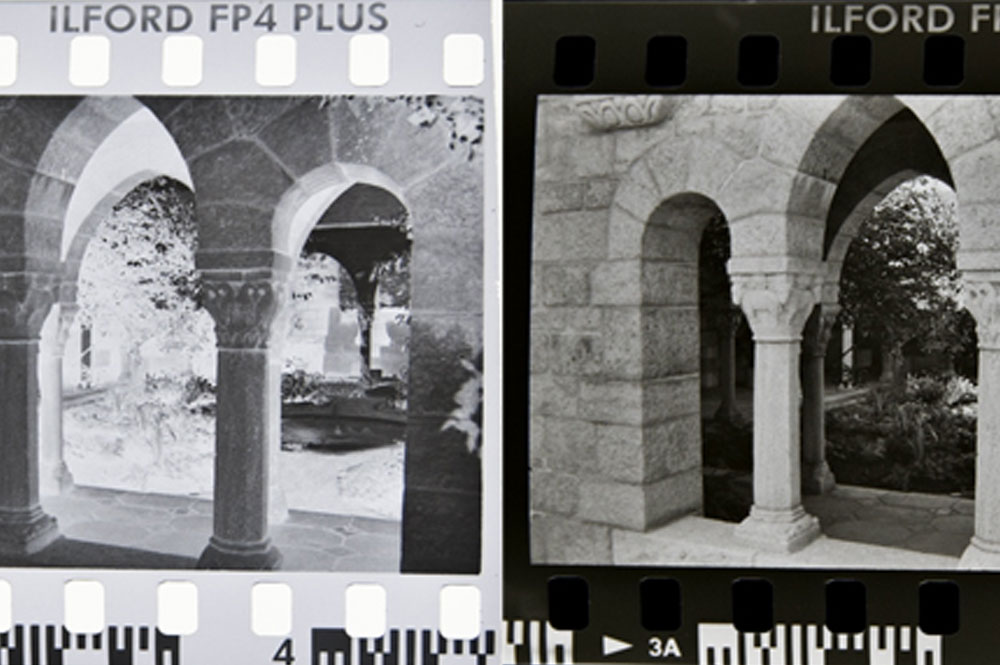
The image on a black and white film negative is actually the inverse of the actual image. That is to say, all the areas that show clear on the negative will be black on the print and all black areas of the negative will show white. When printing onto photo paper light is able to pass through the clear areas of the negative resulting in more light hitting the paper and leading to a dark spot. Black areas of the negative are the opposite, resulting in less light hitting the paper to leave a white spot. Of course, there are many shades of gray in between depending on the density of the negative. Here is an example of a black and white negative and it’s printed counterpart.
Simple black and white films are made of three layers. First, there is a light-sensitive emulsion layer. The emulsion contains grains of silver salt that are able to absorb light and react with a developing chemical to break down into pure silver, remove the silver, and reveal an image on the negative. Second is a layer of plastic to support the emulsion. Third is an anti-halation layer that is used to capture light and refrain it from bouncing back to the emulsion. This final layer eliminates blurry images or foggy film.
The amount of silver salt and grain in black and white film decides whether the film is more or less sensitive to light. Fine grain film will require more light to produce an image and large grains will require less light to produce an image. The amount of grains on the film help determine the ISO film speed of the black and white film. Fine grain leads to slow film and large grain leads to fast film. To learn more, please see the ISO film speed page.
Black and White Film Brands and Types
|
Brand
|
Name |
ISO |
Grain |
Notes |
|
Ilford |
Pan F |
50 |
Extremely Fine |
Very fine detail and lack of grain; good for fine art photography. |
|
Kodak |
T-Max 100 |
100 |
Extremely Fine |
General purpose film, narrow exposure range. |
|
Ilford |
Delta-100 |
100 |
Fine |
General purpose film, wide exposure range. |
|
Fuji |
Neopan 100 |
100 |
Fine |
General purpose film, wide exposure range. |
| Fuji | Neopan Acros | 100 | Very Fine | Fine grain quality for a wide range of photography applications. |
|
Kodak |
Plus X |
125 |
Fine |
General purpose film, slightly flexible. |
|
Ilford |
FP 4 |
125 |
Very Fine |
Can be underexposed by 2-stops or overexposed by 6-stops. |
|
Kodak |
Tri X |
400 |
Fine |
Ideal for low-light or outdoor scenes, can be pushed 2-stops. |
|
Kodak |
T-Max 400 |
400 |
Fine |
Dim lighting or fast action, can be pushed 2-stops. |
|
Ilford |
HP5 |
400 |
Fine |
Ideal for low-light or outdoor scenes, can be pushed to 3200. |
|
Ilford |
Delta-400 |
400 |
Fine |
Flexible film for fine art photography. |
| Fuji | Neopan 400 | 400 | Fine | Wide exposure latitude, push processing capability to EI 1600 |
|
Kodak |
T-Max |
1200 |
Grainy |
Designed to be pushed to 3200 film speed. |
|
Ilford |
Delta-3200 |
1200 |
Grainy |
Designed to be pushed to 3200 film speed. |
Black and white film is also available in C-41 processing film. If you plan to create or have a darkroom set up for black and white photography, you will not be able to process this film with standard black and white processing and may have difficulties printing it as it is color-based emulsions.